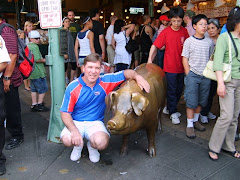
Okay, here I am at Penn State University, my alma mater. This is where I went to college, or university. And in fact, this is where I lived. I moved in here 29 years ago, 1979, in Ewing Hall. I lived in this dormitory for three years, up on the second floor.
This whole deal about coming here, and being at my old dormitory from 29 years ago, is actually very weird. I don’t have, uh, very strong feelings about this place, about Penn State, or my old dormitory—because I actually have, uh, good memories, and I have bad memories.
And so what does that mean? Um, well first of all, let me tell you why I’m here. I’m here because I’m helping my brother bring my nephew back home. He is a student here at Penn State University. So, I came up for a visit—I’m all the way from Taipei—I’m in State College, Pennsylvania, here in the beginning of May.
But I wanted to mention to you the significance of not putting too much importance on whatever happens at your university. Because even though I had some really difficult times here, it doesn’t mean anything now. I had some really good times here—doesn’t mean anything now.
So, apply that to your day today. If things go really poorly, if things don’t go your way, if you lose a relationship, somebody tells you they don’t love you anymore, you lose a job—don’t go out and kill yourself because of it. You’ll survive.
I actually fell in love with a girl in this next dormitory over here—the girl’s dormitory, Cross Hall—and she broke up with me after six months; I was depressed for three years. I survived—I’m very happy today.
So, whatever happens in you university experience, or even in your job today, don’t make much of it. Okay.
In a short period of time, you’ll survive, you’ll make it past, don’t do anything stupid. Okay. So, I actually can’t wait to leave this place. I—I don’t even want to be here.
Key Words
Alma mater—n, the college or university you attended, graduated from.
Dormitory—n, building that students live in.
Significance—n, meaning or value of something.
Broke up—v.ph, to end a relationship with someone.
Depressed—adj, sad, gloomy, dejected.
Friday, November 7, 2008

Friday, October 17, 2008
"Don't Be So Cheap!" (Tips on Tipping)
Okay, we’re here a TGIFriday’s in Taipei. Free beer tomorrow.
This is William—Hi—“Hi, nie hao”. Say Merry Christmas—“Merry Christmas, Sheng dan jei kwai la”.
Okay, William’s going to help us out here with our video, and, uh, I’ve got my friend Christopher from Boston here. Say something—“As-alam-a-lakem”.
Oh, I don’t know what that means, but he says a lot of stuff that I don’t understand. Anyway, I want to make a point to all of our listeners today—is that, um, if you get good service in a restaurant, make sure you leave a good tip for your waiter or waitress.
There’s a problem here in Asia—restaurants serve—charge ten percent “service charge”—but they keep it! They never pass it on to the waiters and waitresses. So be generous, don’t be so cheap—don’t be so cheap! Remember that.
Think about all the money you waste on shoes and clothes and cars and everything—but we never treat our fellow human beings generously. So give a nice tip to your waiters and waitresses—they’ll treat you better the next time you come in, and you’ll feel better.
Christopher always leaves a nice tip when we come in, and, uh, he does it because it’s the right thing to do—it’s the right thing to do. So, don’t be so cheap—remember that!
Are you going to eat all that? “Yeah, I have to, I just got married.”
Key Words
Generous-adj-giving more than is expected. We can be generous with our money, time or attention.
Cheap-adj-cheap usually means that something has a low price. But when describing a person who is “cheap”, we mean that they are not generous, they are not willing to part with their cash, to the degree of this being a negative personality trait.
This is William—Hi—“Hi, nie hao”. Say Merry Christmas—“Merry Christmas, Sheng dan jei kwai la”.
Okay, William’s going to help us out here with our video, and, uh, I’ve got my friend Christopher from Boston here. Say something—“As-alam-a-lakem”.
Oh, I don’t know what that means, but he says a lot of stuff that I don’t understand. Anyway, I want to make a point to all of our listeners today—is that, um, if you get good service in a restaurant, make sure you leave a good tip for your waiter or waitress.
There’s a problem here in Asia—restaurants serve—charge ten percent “service charge”—but they keep it! They never pass it on to the waiters and waitresses. So be generous, don’t be so cheap—don’t be so cheap! Remember that.
Think about all the money you waste on shoes and clothes and cars and everything—but we never treat our fellow human beings generously. So give a nice tip to your waiters and waitresses—they’ll treat you better the next time you come in, and you’ll feel better.
Christopher always leaves a nice tip when we come in, and, uh, he does it because it’s the right thing to do—it’s the right thing to do. So, don’t be so cheap—remember that!
Are you going to eat all that? “Yeah, I have to, I just got married.”
Key Words
Generous-adj-giving more than is expected. We can be generous with our money, time or attention.
Cheap-adj-cheap usually means that something has a low price. But when describing a person who is “cheap”, we mean that they are not generous, they are not willing to part with their cash, to the degree of this being a negative personality trait.
Monday, September 15, 2008
Pittsburgh Submarine and Incline
Well, here we are in my hometown of Pittsburgh, Pennsylvania. There’s downtown, there’s the football stadium, the beautiful three rivers, there’s even the Incline over there—which are these little cars that, uh, go up the side of the mountain. Actually, Pittsburgh has two of them—we’re gonna take a look at that a little bit later on. It’s one of their unique ways of traveling.
But Pittsburgh, like any great city, uh, they’ve got all these great things, and plenty of birds, and that—but what else would a city be without a submarine! The U.S.S. Requin, a retired submarine, is here on display, and we’re gonna go inside and take a look.
This is kind of interesting—we’re in the torpedo room. Those are the tubes where they shoot the torpedoes out. And, get this—here is a torpedo right here. There’s the tail fin of the torpedo, and there is the, uh, warhead up front. Now, how would you like this?—this is a bunk! Guys used to sleep on top of the torpedo. How would you like to sleep on top of this torpedo? Hmmm.
Well, here is the, uh, dining area. It’s a little cramped. And you can see they would, uh, sit here in this tiny dining area, and cook, and here are also some quarters for guys to sleep in. There’s three bunks in there, and they would sleep for four hours at a time. Uh, they would be working for four hours and, uh, they would be off for eight hours.
Alright, we’re gonna come here into the control room, and check everything out. And we saw the engines in the back here, so as far as their speed and their depth in the water.
This is the forward engine room, and, um, the engines—that’s my dad standing right there—and these engines were so loud, these guys worked in here all the time. One of the problems is they did not use ear plugs, and so, uh, because of the constant droning of the engines, most of the guys in here ended up with serious hearing loss and actually going deaf.
And as you can see, it’s not a very big space, and they had 81 guys on this.
Okay, so that’s our trip here, our visit to the U.S.S. Requin. The submarine was brought here to Pittsburgh in 1990, and you can come here or go on board and take a tour. It’s part of the Carnegie Science Center. So, very interesting to walk on a submarine. It was brought up the Mississippi River, all the way up here, then the Ohio River here in Pittsburgh.
So, now we’re gonna go over there and take a look at the Incline.
Okay, we’re here at the top of Mt. Washington, at the Duquesne Incline. Let’s go inside and take a look at this very unique attraction.
This is one of the, uh, cars, the cute red cars that are used on the Incline, to go up and down the hill. And that’s the track right there that goes down the hill. There’s the river, and then there’s the downtown area.
Well, the bell rang, so it should be coming out very soon on its journey down to the, uh, river down there—Ohio River.
I used to ride this, uh, to work. I would go down to the bottom, and catch a bus—and then ride it over to downtown Pittsburgh—go across that bridge. I use to take the Incline in the mornings. That was a long time ago, when I was much younger, and life was much simpler.
Now, this is pretty cool! This is the gear that’s pulling and releasing the cable on the Incline. And this is at the top of the hill, so, uh, the one moving clockwise is pulling the car up the hill.
And here it is, pulling into place—and we’ve got a handful of passengers on board.
But Pittsburgh, like any great city, uh, they’ve got all these great things, and plenty of birds, and that—but what else would a city be without a submarine! The U.S.S. Requin, a retired submarine, is here on display, and we’re gonna go inside and take a look.
This is kind of interesting—we’re in the torpedo room. Those are the tubes where they shoot the torpedoes out. And, get this—here is a torpedo right here. There’s the tail fin of the torpedo, and there is the, uh, warhead up front. Now, how would you like this?—this is a bunk! Guys used to sleep on top of the torpedo. How would you like to sleep on top of this torpedo? Hmmm.
Well, here is the, uh, dining area. It’s a little cramped. And you can see they would, uh, sit here in this tiny dining area, and cook, and here are also some quarters for guys to sleep in. There’s three bunks in there, and they would sleep for four hours at a time. Uh, they would be working for four hours and, uh, they would be off for eight hours.
Alright, we’re gonna come here into the control room, and check everything out. And we saw the engines in the back here, so as far as their speed and their depth in the water.
This is the forward engine room, and, um, the engines—that’s my dad standing right there—and these engines were so loud, these guys worked in here all the time. One of the problems is they did not use ear plugs, and so, uh, because of the constant droning of the engines, most of the guys in here ended up with serious hearing loss and actually going deaf.
And as you can see, it’s not a very big space, and they had 81 guys on this.
Okay, so that’s our trip here, our visit to the U.S.S. Requin. The submarine was brought here to Pittsburgh in 1990, and you can come here or go on board and take a tour. It’s part of the Carnegie Science Center. So, very interesting to walk on a submarine. It was brought up the Mississippi River, all the way up here, then the Ohio River here in Pittsburgh.
So, now we’re gonna go over there and take a look at the Incline.
Okay, we’re here at the top of Mt. Washington, at the Duquesne Incline. Let’s go inside and take a look at this very unique attraction.
This is one of the, uh, cars, the cute red cars that are used on the Incline, to go up and down the hill. And that’s the track right there that goes down the hill. There’s the river, and then there’s the downtown area.
Well, the bell rang, so it should be coming out very soon on its journey down to the, uh, river down there—Ohio River.
I used to ride this, uh, to work. I would go down to the bottom, and catch a bus—and then ride it over to downtown Pittsburgh—go across that bridge. I use to take the Incline in the mornings. That was a long time ago, when I was much younger, and life was much simpler.
Now, this is pretty cool! This is the gear that’s pulling and releasing the cable on the Incline. And this is at the top of the hill, so, uh, the one moving clockwise is pulling the car up the hill.
And here it is, pulling into place—and we’ve got a handful of passengers on board.
Monday, September 1, 2008
Fallingwater
Okay, we are here at Fallingwater, Frank Lloyd Wright’s home that he completed in 1937 for Edgar and Liliane Kaufmann. And, uh, we’re gonna go on a little tour today. So, we’ll take a look inside—the house is actually built over a waterfall—so wouldn’t you like that? To have your house built over a waterfall?
Not your ordinary home: it’s a cantilevered structure—that’s what we call these horizontal lines here, and it was, uh, something that Frank Lloyd Wright designed, therefore, a striking scene. He had his own very modern way of designing homes. Our tour guide just explained that Frank Lloyd Wright never lived here—this was the home of Edgar and Liliane J. Kaufmann—only on the weekends. I’ll pick that up in just a moment.
As I was just mentioning, Frank Lloyd Wright never lived here in this home. It was the weekend getaway for Edgar and Liliane J. Kaufmann and their family—of the Kaufman Department Store heirs. Actually, they founded the Kaufmann Department Store in Pittsburgh.
So, they contracted out Frank Lloyd Wright to design it on this lovely rural piece of property here in the Laurel Mountains of Pennsylvania, approximately one hour east of Pittsburgh.
And I don’t know if the Kaufmann’s came down those steps in the morning to take their morning bath, but it certainly would wake them up, the cold water.
Well, Fallingwater was finished in 1937, and, uh, the guesthouse up behind it was finished in 1939. One interesting thing about this is Frank Lloyd Wright built the house into the hillside, the mountainside, and actually used the stone—right there—as, um, foundation for this. So, uh, he did not destroy the land and he didn’t clear things away like they do today, with all of this.
It was, uh, built at a cost of $155,000, and Wright made a commission of $8,000 back then. So, but of course, today it’s priceless—you could not build it again.
This is the Visitors Center at the Frank Lloyd Wright Fallingwater complex—just beautiful facility nestled into the forest here in the Laurel Mountains outside of Pittsburgh. Just a lovely place—very cool and relaxing.
Okay, so Brad Pitt and Angelina Jolie were here two years ago for Brad Pitt’s birthday party, and, um, nobody else was here, it was a private tour—and I bet you they let Brad Pitt take photographs. Unfortunately, I couldn’t take any photographs up there today, so, but I’m not Brad Pitt—I might look like him, but I’m not Brad Pitt.
So, one more look at Fallingwater outside of Pittsburgh. When you have a chance, come to Pittsburgh and see Fallingwater—Frank Lloyd Wright’s masterpiece. See you next time!
Key Words
Cantilevered (adj) – A projecting structure, such as a beam, that is supported at one end and carries a load at the other end or along its length.
Horizontal (adj) – at right angles to a vertical line.
Striking (adj) – bold, very dramatic, gets your attention.
Contracted (verb) – to hire someone to perform a specific task for a fee.
Rural (adj) – out in the country.
Foundation (noun) – the solid base on which a home or building is built. Usually stone or concrete.
Commission (noun) – the fee paid to someone for completing a task or job.
Nestled (verb) – to lie in a sheltered, protected area.
Brad Pitt (person) – a very famous and handsome American actor often compared to Bill Quinn.
Masterpiece (noun) – a fine work of art, beautiful, perfectly done.
Not your ordinary home: it’s a cantilevered structure—that’s what we call these horizontal lines here, and it was, uh, something that Frank Lloyd Wright designed, therefore, a striking scene. He had his own very modern way of designing homes. Our tour guide just explained that Frank Lloyd Wright never lived here—this was the home of Edgar and Liliane J. Kaufmann—only on the weekends. I’ll pick that up in just a moment.
As I was just mentioning, Frank Lloyd Wright never lived here in this home. It was the weekend getaway for Edgar and Liliane J. Kaufmann and their family—of the Kaufman Department Store heirs. Actually, they founded the Kaufmann Department Store in Pittsburgh.
So, they contracted out Frank Lloyd Wright to design it on this lovely rural piece of property here in the Laurel Mountains of Pennsylvania, approximately one hour east of Pittsburgh.
And I don’t know if the Kaufmann’s came down those steps in the morning to take their morning bath, but it certainly would wake them up, the cold water.
Well, Fallingwater was finished in 1937, and, uh, the guesthouse up behind it was finished in 1939. One interesting thing about this is Frank Lloyd Wright built the house into the hillside, the mountainside, and actually used the stone—right there—as, um, foundation for this. So, uh, he did not destroy the land and he didn’t clear things away like they do today, with all of this.
It was, uh, built at a cost of $155,000, and Wright made a commission of $8,000 back then. So, but of course, today it’s priceless—you could not build it again.
This is the Visitors Center at the Frank Lloyd Wright Fallingwater complex—just beautiful facility nestled into the forest here in the Laurel Mountains outside of Pittsburgh. Just a lovely place—very cool and relaxing.
Okay, so Brad Pitt and Angelina Jolie were here two years ago for Brad Pitt’s birthday party, and, um, nobody else was here, it was a private tour—and I bet you they let Brad Pitt take photographs. Unfortunately, I couldn’t take any photographs up there today, so, but I’m not Brad Pitt—I might look like him, but I’m not Brad Pitt.
So, one more look at Fallingwater outside of Pittsburgh. When you have a chance, come to Pittsburgh and see Fallingwater—Frank Lloyd Wright’s masterpiece. See you next time!
Key Words
Cantilevered (adj) – A projecting structure, such as a beam, that is supported at one end and carries a load at the other end or along its length.
Horizontal (adj) – at right angles to a vertical line.
Striking (adj) – bold, very dramatic, gets your attention.
Contracted (verb) – to hire someone to perform a specific task for a fee.
Rural (adj) – out in the country.
Foundation (noun) – the solid base on which a home or building is built. Usually stone or concrete.
Commission (noun) – the fee paid to someone for completing a task or job.
Nestled (verb) – to lie in a sheltered, protected area.
Brad Pitt (person) – a very famous and handsome American actor often compared to Bill Quinn.
Masterpiece (noun) – a fine work of art, beautiful, perfectly done.
Friday, July 18, 2008
Airplane on Glacier
On my recent trip to America I took a plane ride around Mt. McKinley in Alaska, the tallest mountain in North America, at over 20,000 feet. The plane landed on a glacier in the mountains, using ski's. I will have a longer, better video of the flight later. Here's the text:
Okay, here we are, we just landed on the Ruth Glacier in our DeHaviland Beaver. Our pilot Rico landed us here, and it was a beautiful thing, a beautiful thing.
We're gonna take off from the glacier, so--you ever see a plane land on ski's?
Okay, and then we're gonna head down that way--I'll have J.D. show us a little panorama of the beautiful mountains. We're gonna take off from the glacier and sail off into the sunset!
Okay, here we are, we just landed on the Ruth Glacier in our DeHaviland Beaver. Our pilot Rico landed us here, and it was a beautiful thing, a beautiful thing.
We're gonna take off from the glacier, so--you ever see a plane land on ski's?
Okay, and then we're gonna head down that way--I'll have J.D. show us a little panorama of the beautiful mountains. We're gonna take off from the glacier and sail off into the sunset!
Mt. McKinley airplane ride (short version)
Here's a short video of my plane ride to Mt. McKinley in Alaska.
Friday, June 6, 2008
Back from Vacation!
I apologize to everyone for not updating my blog recently--I was on vacation for a long visit back to the United States. Now that things are back to normal I'll have some new posts and videos from my trip. Thanks! Bill
Monday, April 28, 2008
Can You Teach Ethics? feature for Advanced (text)
Dr. Gray: Welcome to “Should I, or Shouldn’t I”, the ethical call in program where you can ask me, Dr. Gray, how to handle your ethical dilemmas. Go ahead Sally, you’re first!
Sally: Oh, hi Dr. Gray, thanks for taking my call.
Dr: Oh, my pleasure, Sally. Now, how may I help you?
Sally: Well, I’ve got a problem at work Dr. Gray. I run the accounting department, and so I approve all of the expense reports for our sales people. They do a lot of PR work and . . .
Dr: Hmmm, okay, that’s a starting point. What seems to be the problem?
Sally: (Sigh) My boyfriend, see, he is one of the salesmen, and yesterday he told me that he’s been charging his golf games to the company account for the past seven years.
Dr: Oh boy! How much money do you think that has been, Sally?
Sally: Well, he really likes to play golf, and he’s really good at it, in fact just last week he had his best score ever, and was so happy that . . .
Dr: Sally, Sally, how much money has he charged the company for golf over the last seven years?
Sally: Uh, about $10,000. But he’s a good salesman, and everyone likes him.
Dr: Sally, Sally, I know you want to side with your boyfriend on this, but you have to do what’s right. Have you told anyone, yet?
Sally: Oh heavens, no! He’d lose his job, then I’d have to support him!
Dr: Sally, I’ve seen this before. He needs to come clean on this, admit what he’s done, and work out a plan to repay the company for all his golf games.
Sally: That’s so much money, Dr. Gray.
Dr: Sally, in the long run, it’s the best thing for both of you. Honesty is the best policy.
Sally: But he bought me this nice engagement ring!
Dr: You’re thinking about marrying this idiot? Sally, Sally, you need to come clean on this—it’s the best for both of you.
Sally: Oh, okay Doctor, thanks for your help.
Dr: Thanks for calling Sally.
Sally: Oh, hi Dr. Gray, thanks for taking my call.
Dr: Oh, my pleasure, Sally. Now, how may I help you?
Sally: Well, I’ve got a problem at work Dr. Gray. I run the accounting department, and so I approve all of the expense reports for our sales people. They do a lot of PR work and . . .
Dr: Hmmm, okay, that’s a starting point. What seems to be the problem?
Sally: (Sigh) My boyfriend, see, he is one of the salesmen, and yesterday he told me that he’s been charging his golf games to the company account for the past seven years.
Dr: Oh boy! How much money do you think that has been, Sally?
Sally: Well, he really likes to play golf, and he’s really good at it, in fact just last week he had his best score ever, and was so happy that . . .
Dr: Sally, Sally, how much money has he charged the company for golf over the last seven years?
Sally: Uh, about $10,000. But he’s a good salesman, and everyone likes him.
Dr: Sally, Sally, I know you want to side with your boyfriend on this, but you have to do what’s right. Have you told anyone, yet?
Sally: Oh heavens, no! He’d lose his job, then I’d have to support him!
Dr: Sally, I’ve seen this before. He needs to come clean on this, admit what he’s done, and work out a plan to repay the company for all his golf games.
Sally: That’s so much money, Dr. Gray.
Dr: Sally, in the long run, it’s the best thing for both of you. Honesty is the best policy.
Sally: But he bought me this nice engagement ring!
Dr: You’re thinking about marrying this idiot? Sally, Sally, you need to come clean on this—it’s the best for both of you.
Sally: Oh, okay Doctor, thanks for your help.
Dr: Thanks for calling Sally.
Wednesday, April 16, 2008
Taipei International Book Exhibition (MP3 at teacherbill.com)
Bill: Okay, Bryan and I are here at the Taipei International Book Exhibition, and it’s the last day of the Book Exhibition. So—just wanted to show everybody a little bit of the exciting times here. And, uh, there’s been a lot of people come here all weekend, and to see our books and magazines. Um, it’s been a good time, and we’ve had a chance to say hello to many students. And, uh, what about you Bryan?
Bryan: Yeah, it’s been an exciting time, it’s been good to see people get excited about the different products, and to learn more about how to study—how to study.
Bill: Alright. Well, speaking of how to study, one of the questions I get asked all the time Bryan, is “How can people improve their English?” Now which—give me one idea.
Bryan: Okay, one idea is to imitate or mimic the sounds of an English teacher, like Bill. And a good way to do that is to get the Super (guan-tia), the Super CD-ROM. You can listen to Bill, and you can speak along with him—you can imitate his voice. That’s a good way.
Bill: Okay, very good. And you often hear Bryan on the Studio Classroom MP3, and Lisa, who is our camera person right now. So, one other idea I’ve got for student, I wanna tell people is, if you have a chance, join, like, an organization at a university, or a club that, uh, all universities have English clubs or things like that. Or even a speech group, like Toastmasters International.
Okay, well thanks Bryan, for joining me.
Bryan: Thank you.
Bill: Thanks everybody for joining us—live from the Taipei International Book Exhibition, Bryan and Bill.
Both: Bye Bye!
Key Words
Exhibition-n-a large show, gathering or convention that displays products.
Imitate-v-to act or sound like someone, closely resemble that persons actions.
Mimic-v-to repeat word for word what a person says.
Toastmasters International-n-a group that meets weekly to practice and improve public speaking ability.
Bryan: Yeah, it’s been an exciting time, it’s been good to see people get excited about the different products, and to learn more about how to study—how to study.
Bill: Alright. Well, speaking of how to study, one of the questions I get asked all the time Bryan, is “How can people improve their English?” Now which—give me one idea.
Bryan: Okay, one idea is to imitate or mimic the sounds of an English teacher, like Bill. And a good way to do that is to get the Super (guan-tia), the Super CD-ROM. You can listen to Bill, and you can speak along with him—you can imitate his voice. That’s a good way.
Bill: Okay, very good. And you often hear Bryan on the Studio Classroom MP3, and Lisa, who is our camera person right now. So, one other idea I’ve got for student, I wanna tell people is, if you have a chance, join, like, an organization at a university, or a club that, uh, all universities have English clubs or things like that. Or even a speech group, like Toastmasters International.
Okay, well thanks Bryan, for joining me.
Bryan: Thank you.
Bill: Thanks everybody for joining us—live from the Taipei International Book Exhibition, Bryan and Bill.
Both: Bye Bye!
Key Words
Exhibition-n-a large show, gathering or convention that displays products.
Imitate-v-to act or sound like someone, closely resemble that persons actions.
Mimic-v-to repeat word for word what a person says.
Toastmasters International-n-a group that meets weekly to practice and improve public speaking ability.
Subscribe to:
Posts (Atom)